The Strategy Subsystem is the command centre of our vehicle—the system that decides, every second, how fast to go, how efficiently to use power, and how best to harness the sun.
What began as a physics-based simulator has evolved into an ML-driven framework that fuses aerodynamics, energy flow, and solar dynamics to calculate the optimal speed for every kilometre of a race. This isn't just software; it's cognition in motion!
From Equations to Intelligence
Built entirely in Python, the first version of our simulator used the Newton-Raphson method to compute race speeds for a 150 km endurance run while maintaining 60% battery charge at the finish line.
It modelled aerodynamic drag, rolling resistance, terrain effects, and real-world motor and battery behaviour, forming a digital twin of our vehicle that laid the foundation for machine learning to take over.
When the Machine Started Learning
To move beyond pure computation, we generated 50,000+ synthetic race simulations and trained machine learning models to predict optimal speeds under varying gradients, irradiance, and wind conditions.
# Model benchmark
model = RandomForestRegressor(n_estimators=100, ...)
model.fit(X_train, y_train)
print(f"Model R² Score: {model.score(X_test, y_test)}")
Performing in milliseconds what physics solvers took minutes to compute.
Embracing Uncertainty
Real races are unpredictable, so our subsystem evolved into an Uncertainty-Aware AI Framework:
- Data Augmentation & Hyperparameter Optimisation to improve generalisation under poor weather.
- Monte Carlo Markov Chains (MCMC) for probabilistic speed distributions.
- Stochastic Model Predictive Control (MPC) for real-time risk-aware decisions.
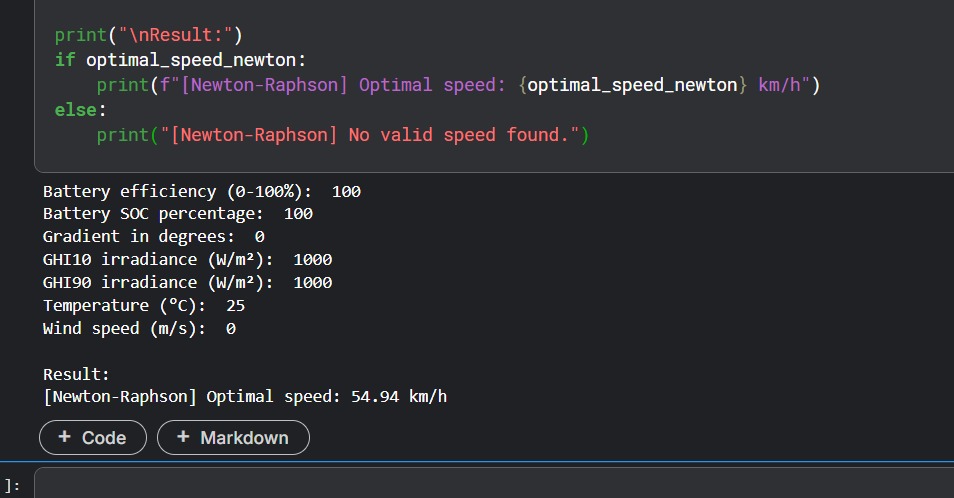
What's Next
Real-world Telemetry
Capture driver and power dynamics from actual race data.
Explainable AI (XAI)
Implement for transparent model interpretation and trust.
Advanced Forecasting
Research ARIMA, SVM, LSTM, and Bayesian control models.
Fair-by-Design
Research fair-by-design charge scheduling.